How Much Does a Bali Helicopter Charter Cost in 2024?
How Much Does a Bali Helicopter Charter Cost in 2024?
- Aircraft Choice: A 4-seater Robinson R66 is significantly less expensive than a 6-seater luxury Airbus H130.
- Flight Route: A 30-minute coastal tour has a different cost calculus than a 50-minute inter-island transfer to Lombok.
- Ancillary Fees: Custom landing permits, airport handling, and pilot standby time contribute to the total investment.
The air is thick with the scent of frangipani and clove, a familiar Bali welcome. But from this altitude, 500 feet above the snaking traffic of the Canggu shortcut, a different sensation takes over. The low, rhythmic thrum of the rotor blades becomes the island’s new heartbeat. Below, the emerald green of the rice paddies unfolds not as a patchwork but as a single, immense , woven with the ancient Subak irrigation system. This is Bali, untethered from the constraints of the ground. It’s a perspective that transforms the familiar into the magnificent. For the discerning traveler, the question isn’t whether this experience is desirable, but rather, what is the precise investment required to access this extraordinary view of the Island of the Gods in 2024?
The Core Components of Your Charter Quote
Understanding the cost of a private helicopter charter in Bali requires looking beyond a simple hourly rate. The final figure on your invoice is a composite of several critical, interlocking factors. Think of it less like a taxi meter and more like commissioning a bespoke piece of art. The primary driver, of course, is the aircraft itself. Operators like Bali Private Heli Place maintain a fleet where each helicopter serves a different purpose and carries a distinct price point. For instance, the Robinson R66, a reliable turbine-powered workhorse seating four passengers, represents the entry point, typically billed between $1,500 and $2,500 per hour. In contrast, the Airbus H130, known for its spacious, climate-controlled cabin, stadium seating for six, and significantly quieter Fenestron tail rotor, commands a premium, often in the range of $4,000 to $6,000 per hour. For executive transfers, a twin-engine Bell 429 might be sourced, pushing the cost even higher.
Beyond the hardware, flight time is the next crucial variable. This is calculated from “engine on” to “engine off,” and most charters have a minimum booking time, often 30 or 60 minutes. Then there are the human elements: the cost of the highly experienced pilot and, for certain aircraft or regulations, a co-pilot, is factored into the operational cost. Finally, the logistical fees add another layer. Landing at a designated helipad at a luxury resort like Amankila or Mandapa, a Ritz-Carlton Reserve, isn’t free. These landing and handling fees can range from a modest $250 to over $1,000, depending on the exclusivity and services provided at the location. These are the foundational elements that build the base price for any aerial journey.
A Tale of Two Itineraries: Scenic Tour vs. Island Transfer
To truly grasp the spectrum of Bali helicopter charter costs, let’s analyze two distinct, popular itineraries. The first is a classic scenic tour: the 45-minute “Uluwatu Temple & Bukit Peninsula” flight. Departing from a helipad near Nusa Dua, this journey offers an perspective on Southern Bali. The helicopter banks over the iconic surf breaks of Padang Padang and Bingin, revealing the turquoise water and the surfers who appear as tiny black specks. The flight culminates in a dramatic orbit around Uluwatu Temple, perched precariously on a cliff 70 meters above the churning Indian Ocean. For this type of experience, using a cost-effective Robinson R66, a client could expect a quote in the region of $1,600 to $2,200. The value here is purely experiential—a condensed, powerful dose of Bali’s coastal grandeur that would take a full day to appreciate from the ground.
The second scenario is a logistical masterpiece: a one-way transfer from Bali to Gili Trawangan, the largest of the three Gili Islands off the coast of Lombok. By land and sea, this journey is a 4-hour commitment involving a car transfer to Padang Bai harbor and a crowded fast boat. By air, it’s a direct 45-minute flight. This mission requires a more powerful aircraft like the Airbus H125 or H130 to handle the over-water crossing and passenger load. The cost for such a transfer typically falls between $5,500 and $7,000. While the price is substantially higher, the value proposition shifts from experience to time and exclusivity. For a family on a tight schedule or a high-profile guest seeking privacy, avoiding hours of transit and arriving in style is a justifiable luxury. This is the ultimate expression of what a bali private heli service can provide: turning a travel day into a travel moment.
Beyond the Flight: The Hidden Variables That Shape Your Price
The most sophisticated travelers know that the advertised hourly rate is just the beginning. Several less-obvious factors can materially influence your final Bali helicopter charter cost. Chief among these are repositioning fees, also known as “empty legs.” If your desired departure point is a private villa in Tabanan, but the helicopter is based in Nusa Dua, you will be charged for the time it takes the aircraft to fly from its base to you. This can easily add 20 to 40 minutes of billable flight time to your charter. Similarly, if you plan an excursion that involves the helicopter waiting for you—for instance, a three-hour lunch at a remote cliffside restaurant—you’ll incur standby fees. These charges compensate the operator for having an aircraft and pilot on call, and they typically range from $200 to $500 per hour.
Furthermore, regulatory and administrative costs can play a significant role. According to I Nyoman Cadra, a lead pilot with over 8,000 flight hours in the region, “Securing permits for non-standard landing zones or flights over sensitive areas like the Mount Agung crater exclusion zone requires detailed flight plans and approvals from Indonesian aviation authorities. This process can take weeks and adds a few hundred dollars in administrative fees to the charter cost.” Seasonality also impacts pricing. During Bali’s peak season, from June to August and again over the December holidays, demand for helicopters can surge by as much as 30%. This heightened demand can lead to higher rates and limited availability, making advance booking essential. These are the granular details that separate a standard booking from a meticulously planned, seamless aerial experience.
The Aircraft Fleet: Matching the Helicopter to Your Mission
The choice of helicopter is the most significant decision influencing both the cost and the quality of your experience. The fleet available for charter in Bali is diverse, tailored for everything from romantic scenic flights to heavy-duty utility transfers. The Robinson R66 Turbine is the prevalent entry-level option. Seating four passengers in a 2+2 configuration, it offers a fantastic introduction to rotary flight with a cruise speed of around 120 knots (222 km/h). It’s the ideal platform for couples or small families on shorter coastal tours. Moving up the scale, we find the Airbus H125 (often known by its legacy name, the AS350 Écureuil). This single-engine powerhouse seats five passengers and is renowned for its performance at high altitudes, making it a favorite for flights near Bali’s volcanoes. Its versatility and power are why it’s a global bestseller.
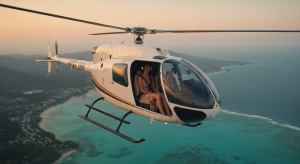
For those prioritizing comfort and the ultimate viewing experience, the Airbus H130 is the undisputed champion of the Bali tourism market. It seats six passengers in a forward-facing “stadium seating” arrangement, ensuring that even those in the back have unobstructed views through the expansive wrap-around windows. Its enclosed Fenestron tail rotor makes it nearly 50% quieter than other helicopters in its class, a feature that enhances the passenger experience and reduces noise impact on the ground. At the apex of the market is the Bell 429, a corporate-configured, twin-engine helicopter. Offering seating for up to seven passengers and the enhanced safety of two engines, this is the aircraft of choice for VIPs and executives requiring airport-to-resort transfers with the utmost discretion and security. Its operating cost is the highest, often starting at $7,500 per hour, reflecting its advanced capabilities and luxury appointments.
Is a Bali Helicopter Charter Worth the Investment?
After analyzing the costs, the ultimate question remains: is it worth it? The answer lies in reframing the expense from a simple cost to a strategic investment in the most valuable, non-renewable resource on any vacation: time. A drive from the Uluwatu cliffs to the cultural heart of Ubud can consume over two hours of your day in traffic. A helicopter makes that same journey in just under 20 minutes. That’s more than an hour and a half of your life reclaimed—time that can be spent by the pool, exploring a temple, or enjoying a meal, rather than staring at the back of a scooter. This time-saving equation becomes even more compelling when considering travel to neighboring islands like Nusa Lembongan or Lombok.
Beyond pure efficiency, a helicopter provides a level of access that is simply unattainable by any other means. It allows you to witness the striking majesty of the UNESCO-listed Subak irrigation landscape as a complete, interconnected system. It can transport you to the caldera of Mount Batur for a sunrise view that few will ever see. It unlocks remote beaches and private estates that are otherwise a logistical nightmare to reach. As highlighted on Indonesia’s official tourism website, the archipelago’s true beauty is its diversity, and a helicopter is the key to unlocking that diversity in a single trip. The experience itself—the feeling of gracefully lifting off the ground and seeing the world shrink below—becomes a central, memorable memory of your journey. It’s not just transport; it’s a transformation of perspective.
Quick FAQ on Bali Helicopter Charter Costs
How much is a 15-minute helicopter ride in Bali?
A short, 15-minute “taster” flight, often covering a localized area like the Nusa Dua coastline or Tanah Lot temple, typically costs between $700 and $1,000 USD. The final price depends on the operator and the type of helicopter used, with the Robinson R44 or R66 being the most common for these brief aerial snapshots.
Can you fly a helicopter to the Gili Islands or Nusa Penida?
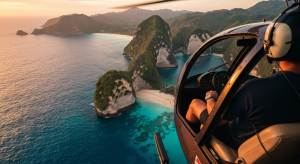
Absolutely. Helicopter transfers to Gili Trawangan and Nusa Penida are increasingly popular. A one-way flight to Gili Trawangan takes approximately 45-50 minutes and costs around $5,500 to $7,000. A shorter flight to Nusa Penida to see Kelingking Beach from above takes about 20-25 minutes and would be priced closer to $2,500 to $3,500 for a one-way transfer, depending on the aircraft.
Are there strict weight and luggage restrictions?
Yes, safety is paramount. Every helicopter has a maximum takeoff weight that cannot be exceeded. Operators enforce both a per-seat weight limit (usually around 130 kg or 285 lbs) and a total payload limit for all passengers and luggage combined. It is critical to provide accurate passenger weights and luggage details during the booking process. Luggage is typically restricted to soft-sided bags to fit in the limited cargo compartments.
Ultimately, the decision to charter a helicopter in Bali is a decision to invest in an experience. It’s about trading congested roads for open skies, hours for minutes, and standard views for spectacular panoramas. The cost, while significant, buys you the most precious of commodities: time, access, and memories that will define your visit to the island. When you are ready to elevate your Bali itinerary and design a journey that is as seamless as it is extraordinary, the sky is not the limit—it is the destination. Explore our fleet and request a bespoke quote for your Bali private heli adventure today.