The Best Private Bali Helicopter Tours for Breathtaking Volcano Views
The Best Private Bali Helicopter Tours for Breathtaking Volcano Views
- Gain access to remote caldera rims and recent lava fields.
- Enjoy fully customizable flight paths that can include coastal temples and rice terraces.
- Fly in state-of-the-art Airbus H125 or twin-engine Bell 429 helicopters.
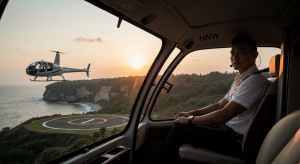
The low, rhythmic thrum of the rotors vibrates through the cabin floor. Below, the manicured lawns of the Nusa Dua helipad shrink with surprising speed, replaced by a mix of aquamarine reefs and the white wakes of fishing jukungs. This is the moment of transition, where the Bali of the guidebooks—the traffic-clogged streets, the crowded beach clubs—dissolves into its true, elemental form. As we bank north, the southern peninsula gives way to a dense emerald carpet, and then, piercing the distant haze, the unmistakable silhouettes of the island’s two titans appear. From this vantage point, you are not merely a visitor; you are a surveyor of a living, breathing geological masterpiece.
Beyond the Infinity Pool: Why a Helicopter Tour is the Definitive Bali Experience
For the discerning traveler, time is the ultimate luxury, and on an island as geographically compressed yet logistically challenging as Bali, ground travel can be the greatest thief of that commodity. A journey from a villa in Canggu to the Kintamani highlands to see Mount Batur can consume upwards of three hours each way, a significant portion of a day spent navigating winding roads and unpredictable traffic. That same journey, by air, takes approximately 25 minutes. This is not just about efficiency; it is about fundamentally changing your relationship with the island. The Bali road network, which saw traffic volumes increase by over 8% in the final year before the 2020 downturn, often reduces average travel speeds to a frustrating 15 kilometers per hour. A helicopter, by contrast, cruises at over 220 kilometers per hour, transforming the island from a series of disconnected destinations into a single, cohesive landscape. This is what I call volumetric luxury—the ability to appreciate the full three-dimensional scale of a place. From the air, you can trace the path of ancient lava flows from the mountain peak all the way to the sea, a geographical narrative completely lost at ground level. This is the perspective that contextualizes everything, and for those who value insight as much as indulgence, an aerial tour is no longer an extravagance but an essential component of a Bali itinerary.
The Titans of the Island: A Pilot’s-Eye View of Agung and Batur
To truly understand Bali, one must understand its volcanoes. They are not mere geological features; they are the spiritual anchors of the island. Dominating the eastern skyline is Mount Agung, the island’s highest and most sacred point, soaring to 3,031 meters (9,944 feet). As our chief pilot often explains during his pre-flight briefings, “Agung is the throne of the gods. We treat it with immense respect.” Flying a respectful circumference around its peak, you can observe the dramatic landscape carved by its most recent eruptive phase between 2017 and 2019. The eruption column during that period reached an altitude of 25,000 feet, and from the air, you can still identify the grey channels of pyroclastic flow material. On its southwestern slope, the sprawling complex of Pura Besakih, Bali’s revered Mother Temple, is a remarkable sight, its many-tiered meru towers appearing like miniature monuments against the volcano’s immense scale. Further west lies Mount Batur, a caldera of epic proportions. While smaller than Agung, it is arguably more visually dramatic from the air. The vast outer caldera, measuring 13.8 by 10 kilometers, contains a deep freshwater lake and a smaller, active volcanic cone. This is the view that defines the Kintamani region. From our aerial vantage point, we can trace the dark, frozen rivers of solidified lava from the 1968 eruption, a stark reminder of the forces simmering just beneath the surface. For more on Agung’s geological history, its Wikipedia entry offers a detailed chronicle of its activity.
Anatomy of an Elite Charter: What to Expect from a Volcano Expedition
The experience of a private volcano tour begins long before takeoff. It starts with a consultation in a quiet, air-conditioned lounge, where the flight path is discussed over fresh coffee. The aircraft of choice for these premier excursions are typically the Airbus H125 or H130, renowned for their panoramic windows and seating for up to six passengers, or the Bell 429, a twin-engine VIP helicopter offering a smoother, quieter ride. Once aboard, guests are fitted with Bose noise-canceling headsets, allowing for crystal-clear communication with the pilot, who serves as an expert aerial guide. A standard “Volcanoes and Lakes” tour lasts approximately 75 minutes, covering a flight distance of over 250 kilometers. But the journey is rarely a direct line. A well-curated flight plan weaves a narrative. The ascent might follow the Ayung River valley, offering glimpses of world-class resorts before climbing over the Tegalalang rice terraces. After circling the Kintamani caldera, the return leg often follows the eastern coastline, providing views of remote black sand beaches and the cliffs of Uluwatu. This level of personalization is what defines a true Bali Private Heli: The Definitive Helicopter Charter Service experience. It transforms a simple sightseeing trip into a bespoke aerial expedition, tailored to your specific interests, whether they be geology, photography, or simply the pursuit of an perspective on the Island of the Gods.
The UNESCO Geopark Route: Circling the Kintamani Caldera
In 2012, UNESCO officially recognized the Mount Batur caldera as a Global Geopark, a designation that highlights its international geological significance and its deep connection to local culture. An aerial tour is, without question, the most effective way to comprehend the scale and complexity of this protected landscape. From a height of 6,000 feet, the entire geological story unfolds beneath you. You can clearly distinguish the rim of the vast outer caldera, formed by a cataclysmic eruption some 29,300 years ago. Inside this massive basin, the crescent-shaped Lake Batur, Bali’s largest lake at 7.5 kilometers long, gleams against the dark volcanic soil. And rising from the center is the active inner cone, Mount Batur itself, which has been consistently active for centuries. This unique “caldera within a caldera” formation is a textbook example of volcanic evolution. The flight path allows you to see how the local communities, the Bali Aga, have built their villages like Trunyan right on the lake’s edge, living within the embrace of this powerful natural force. This aerial view also provides critical context for Bali’s celebrated cultural landscape, particularly the Subak irrigation system, which is also a UNESCO World Heritage site. The volcanic lakes and the rainfall captured by the mountains are the ultimate source of the water that feeds this intricate network of canals and temples, a system of “divine hydrology” that becomes beautifully apparent from above.
Curating Your Flight: Custom Itineraries and Exclusive Landings
The pinnacle of luxury air touring lies in its capacity for customization. While the volcano routes are deservedly popular, the true potential of a bali private heli charter is realized when it becomes a tool for crafting a unique and seamless day. The possibilities are limited only by imagination and landing permissions. For instance, a morning flight over Mount Batur can be followed by a landing on the secluded white sands of Gili Meno for a private lunch, bypassing the two-hour drive and 90-minute boat transfer. We recently arranged an itinerary for a professional photographer that included a doors-off flight over the Kintamani caldera at dawn, followed by a low pass over the USAT Liberty shipwreck in Tulamben, and concluded with a landing at a private villa in the Sidemen Valley. This is logistical poetry, connecting disparate parts of the island into a single, fluid experience. Many of the island’s top-tier resorts, from Amankila to Mandapa, a Ritz-Carlton Reserve, have helipads, allowing for spectacular “heli-dining” excursions. Securing these exclusive landing permits, which can sometimes add over $1,000 to a charter’s cost, is a service that separates premier operators from the rest. It is about transforming the helicopter from a mode of transport into a key that unlocks the most exclusive and remote corners of the island, far from the well-trodden tourist path. As Indonesia’s Ministry of Tourism continues to promote high-value travel experiences, these bespoke aerial journeys are becoming the new benchmark, as detailed on their official portal at indonesia.travel.
Quick FAQ: Your Bali Volcano Helicopter Tour Questions Answered
What is the best time of day for a volcano tour?
Without question, the early morning between 7:00 AM and 9:30 AM offers the highest probability of clear skies and calm air. The volcanic peaks are often free of the cloud cover that tends to build throughout the day, providing the sharpest views and ideal conditions for photography.
How safe are these helicopter tours?
Safety is paramount. Reputable operators in Bali adhere to stringent international aviation standards. The fleet typically consists of meticulously maintained aircraft like the Bell 429 and Airbus H125, flown by internationally licensed pilots with thousands of hours of flight time. Pre-flight safety briefings are mandatory for all passengers.
Can we fly directly over the crater?
For safety and in accordance with aviation regulations concerning active volcanoes, flights do not pass directly over the active vents. Instead, they perform comprehensive orbits around the summit and caldera rim. This trajectory provides a complete, 360-degree perspective of the crater’s interior while maintaining a safe lateral distance.
What should I wear for the flight?
Comfort is key. We advise wearing dark-colored clothing (blacks, navys, greys) to minimize reflections on the cabin windows, which significantly improves the quality of your photographs. The cabin is climate-controlled, but a light sweater or jacket can be a good idea as it can be cool at higher altitudes.
To move beyond the surface and witness the raw, geological power that shaped this island is to understand Bali on a deeper level. It is an experience that re-frames your entire perception of the landscape. To design your own aerial journey and see the majestic volcanoes of the island from a perspective reserved for a select few, explore the fleet and itinerary options at Bali Private Heli Place. Our dedicated concierge team is ready to help you craft the ultimate bali private heli charter, an experience that will undoubtedly become the centerpiece of your time on the island.